The house behind the concert
St. Peter Stiftskeller: the history
What St. Peter Stiftskeller is, what its claim to be Europe's oldest restaurant rests on, and what the Baroque Hall of 1903 adds to the story.
Check seats for your date ↗Quick answer
St. Peter Stiftskeller, renamed St. Peter Stiftskulinarium in 2017, is a restaurant inside St. Peter's Abbey in Salzburg. Its own history dates the house from 803, when a document tied to Alcuin first mentions the Stiftskeller, and it calls itself the oldest restaurant in Europe. Wikipedia is more careful: the house has closed several times, so it is not the oldest one in continuous operation. The Baroque Hall used for the Mozart dinner concert was built in 1903.
The house in dates
| Year | What happened |
|---|---|
| 696 | St. Peter's Abbey founded |
| 803 | Stiftskeller first mentioned |
| 1517 | First rock cellar built |
| 1903 | Baroque Hall built |
| 1996 | Mozart Dinner Concert begins |
Where the house stands
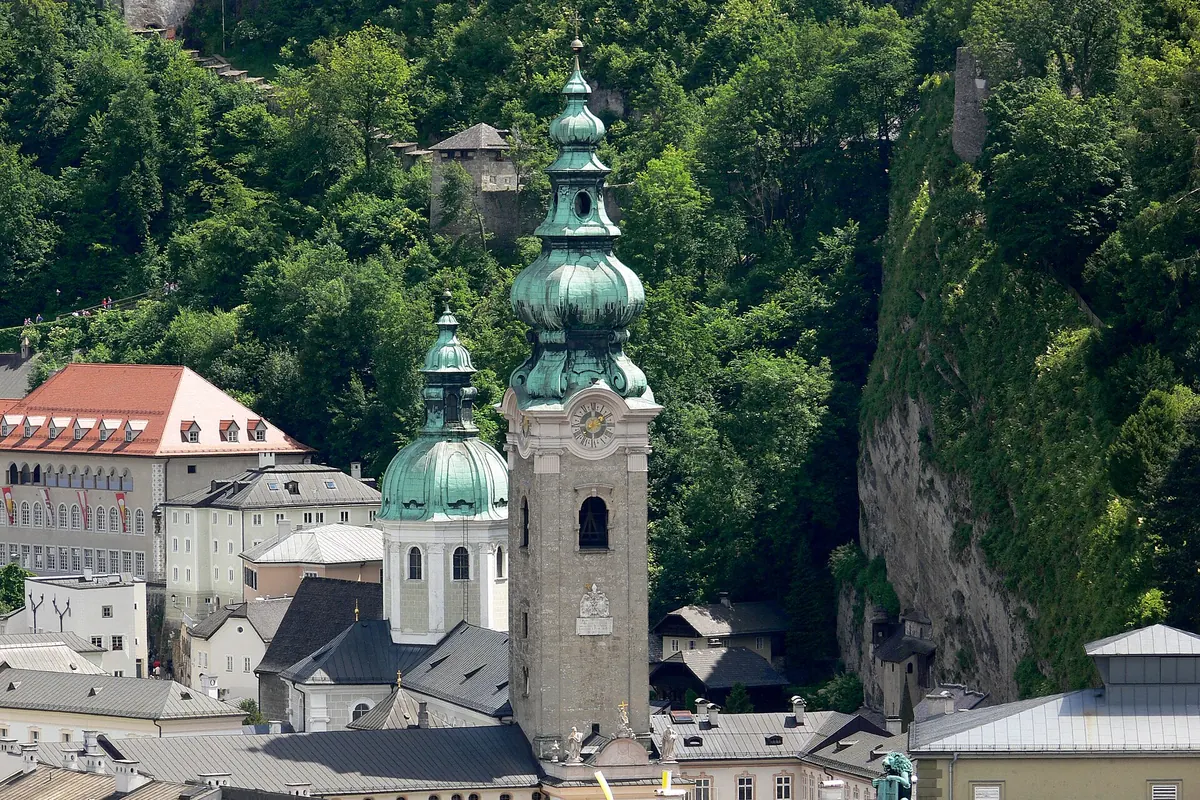
The restaurant sits in the grounds of St. Peter's Abbey, the Benedictine monastery in Salzburg's Old Town. The abbey's own website dates its founding to 696, by Bishop Rupert of Worms, and calls it the oldest monastery in the German-speaking world with an unbroken history. The abbey church stands at the northern foot of the Mönchsberg, and the restaurant is to the right of it. That setting matters for the story: the Stiftskeller began as the abbey's own wine cellar, long before anyone thought of it as a place to dine. Today the house runs a restaurant, a lounge and an events venue from the same precinct, according to its website.
What happened in 803
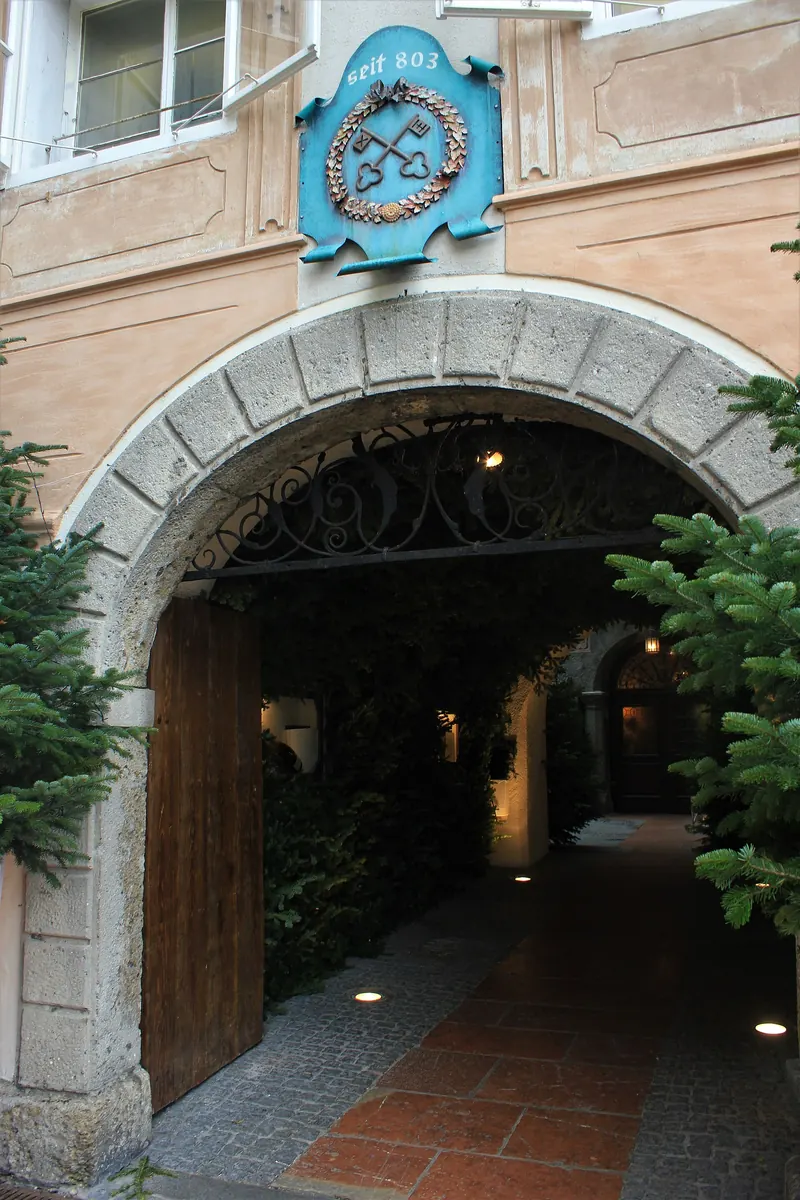
The date on the sign at the entrance is 803. The restaurant's history page says the Stiftskeller was first mentioned in writing that year by Alcuin of York, an adviser to Charlemagne. Wikipedia words the source in two ways, as a deed issued by Alcuin and as a letter to Charlemagne, so treat the document type as unsettled and the year as the fixed point. What the record shows is that a Stiftskeller attached to the abbey existed by 803. It does not show a restaurant serving diners in the modern sense. The restaurant's timeline records a celebration of the house's 1,200th year in 2003, which shows how it counts its own age.
How strong is the oldest-restaurant claim
The restaurant calls itself the oldest restaurant in Europe, and Wikipedia says it claims to be the oldest in Central Europe. Both are claims, not rulings. Wikipedia adds that the house has closed several times in its history, which means it cannot be called the oldest restaurant in continuous operation; that title it gives to Sobrino de Botín in Spain, open since 1725. The fair reading is that the Stiftskeller has among the oldest documented roots of any dining house in Europe, while the label oldest restaurant depends on how you define a restaurant. In practice the label matters less than the setting, because the cellar belongs to an abbey that describes its own history as unbroken since 696.
From wine cellar to inn
The restaurant's history page traces the growth of the house in steps. In 1517 Abbot Wolfgang Walcher had a rock cellar cut with access to the abbey courtyard, and in 1527 Abbot Chillian Pitricher added a second one. Carters and craftsmen working for the abbey received a Weinpfennig or Haustrunk, a ration of wine, and the cellar slowly turned into an inn. In 1803 the house gained the right to serve beer, and in 1809 French soldiers were quartered there during the Napoleonic wars. The same timeline records that the Stiftskeller was plundered in 1918, near the end of the First World War.
Haydn upstairs and Mozart at the table
According to the restaurant's history, the Salzburg composer Haydn lived on the upper floor of the Stiftskeller from 1763. The house also says that Mozart's family dined there and cites Nannerl Mozart's diary for it. Wikipedia treats the idea that Mozart ate there, alongside Columbus and Faust, as local legend. Both statements can stand together: the diary reference is what the restaurant relies on, and the legend is what visitors repeat. What is beyond doubt is that Haydn is buried in the abbey church beside Mozart's sister Nannerl, in the church next to the restaurant. The restaurant also records that around 1300 the house entered literary history through the poet and composer known as the Monk of Salzburg.
1903: the Baroque Hall
The restaurant's own timeline says the Baroque Hall and the Willibaldhöhle were built and extended under Abbot Willibald Hauthaler in 1903, and that the arcades named after him date from about the same years. The hall is a banqueting room in the Baroque style, with stucco and frescoes, not a surviving eighteenth-century room. For a visitor this is useful to know. The hall is handsome and well suited to music, but when the organiser speaks of an evening as it might have been in 1790, that is a matter of costume and repertoire, not of original walls. The arcades in the courtyard, named after the abbot, were built in the same years.
1996: the Mozart Dinner Concert begins
The restaurant dates the first Mozart Dinner Concert to 1996, held in the Baroque Hall, and says it has been performed there ever since. The format pairs a three-course dinner with arias and duets from Mozart operas and the serenade Eine kleine Nachtmusik, performed between the courses by the Amadeus Consort Salzburg. The house itself was renamed in 2017, when the Stiftskeller became St. Peter Stiftskulinarium. That is why you will see both names in older guidebooks and on photographs, such as those on this page. The name of the ensemble, Amadeus Consort Salzburg, appears in both the restaurant's and the organiser's descriptions of the evening.
The abbey church next door
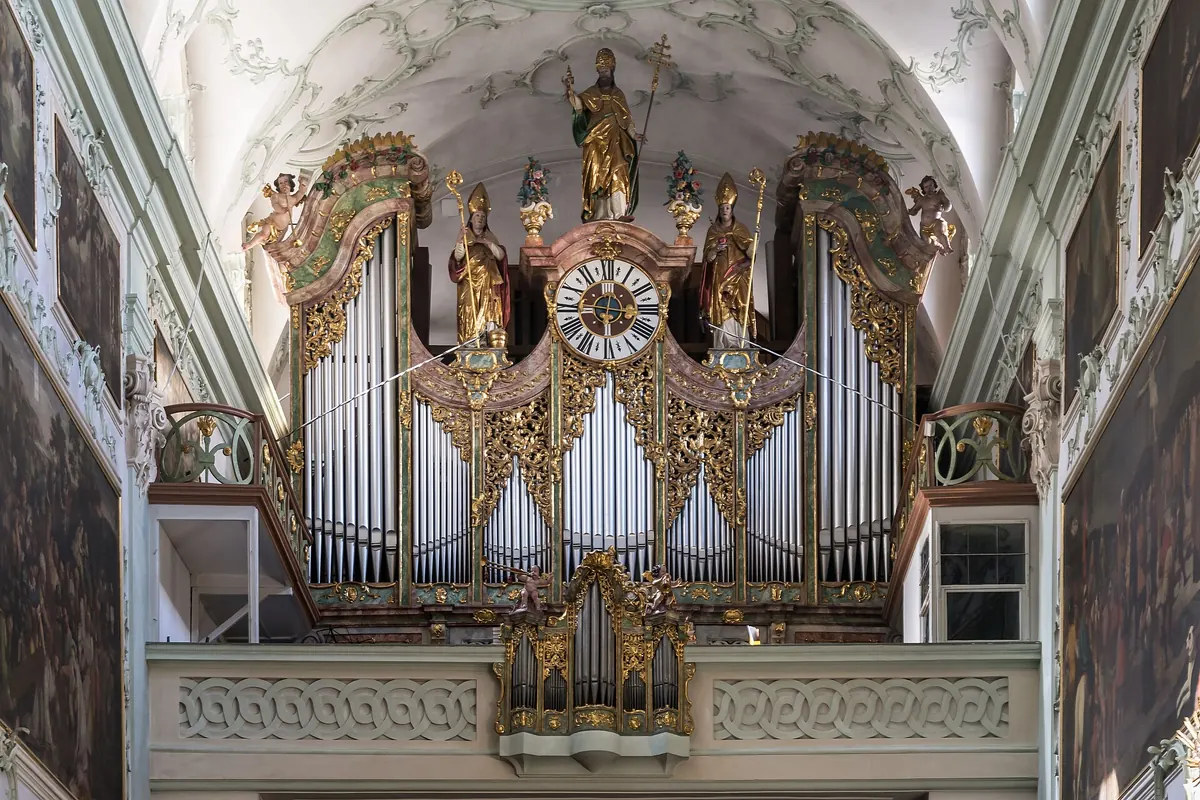
The church beside the restaurant reached its present Rococo interior between 1760 and 1782, under Abbot Beda Seeauer. Mozart's Great Mass in C minor was first performed in it in October 1783, during his 1783 visit to Salzburg with Constanze; the work remained unfinished, and the performance gave the Kyrie, Gloria, Sanctus and Benedictus. The abbey cemetery, the Petersfriedhof, is probably as old as the abbey itself, and its catacombs are cut into the rock of the hill. Visiting hours for the church and cemetery are set by the abbey, so check the abbey's website. The abbey's website says Benedictine monks have lived and worked there since 696, and it lists the church, cemetery and catacombs among the sights of the Old Town.
What a concert evening adds
A dinner concert gives the house a purpose it has had in different forms for centuries: a place where people ate and drank under the abbey's wing. The music is Mozart's, the performers wear period dress, and the Baroque Hall supplies the stucco and the chandeliers. What it adds to the history is atmosphere, not documentation. If you want the documents, read the abbey's and the restaurant's history pages; if you want the atmosphere, the evening is the way to get it, and the guide to what to book explains how. The restaurant also trades separately as a fine-dining house, so a visitor can eat there without the concert.
Read next: Mozart dinner in Salzburg: what to book
Who this isn't for
This house is not for travellers who want a medieval interior or an archaeological site. The rock cellars are old, but the concert is held in the hall of 1903. It is also not a museum: there is no ticketed tour of the Stiftskeller in this guide, only a dinner with music. If you came to Salzburg for the monastery itself, the abbey church, cemetery and catacombs are separate sights with their own opening arrangements, and they do not require a dinner booking. If you want history in the strict sense, the abbey's website and the Wikipedia articles in the source list give more detail than any dinner can.
Frequently asked questions
Is St. Peter Stiftskeller the oldest restaurant in Europe?
It says so itself, and it is documented from 803. Wikipedia notes that it has closed several times, so it is not the oldest in continuous operation.
Is it the same place as St. Peter Stiftskulinarium?
Yes. The house was called St. Peter Stiftskeller until 2017, when it was renamed St. Peter Stiftskulinarium.
What happened in 803?
The Stiftskeller was first mentioned in writing, in a document tied to Alcuin of York, an adviser to Charlemagne. Sources call it a deed or a letter.
Did Mozart eat at the Stiftskeller?
The restaurant cites Nannerl Mozart's diary to say the Mozart family dined there. Wikipedia treats Mozart as a visitor of local legend, so the claim is not settled.
Is the Baroque Hall original?
No. The restaurant says the hall was built in the Baroque style in 1903, with stucco and frescoes.
Can I see the rock cellars?
The concert is held in the Baroque Hall, not in the cellars. Ask the restaurant about its other rooms if you want to see them.
Sources